


An amplifier, or “amp,” is an electromagnetic component that replicates and enhances input signals to achieve desired power and volume levels with minimal distortion. But not all amplifier circuits are created the same. Some are categorized based on their circuit configurations, while others are defined by their property of output or operating modes. This comprehensive guide discusses amp types and classifications, including how to design an operational circuit, and factors to consider when choosing an amplifier.
A Brief History of Amplifiers and Their Importance in Electronics
The triode vacuum tube was the first audio amplifier, invented by Lee De Forest in 1906. The mechanism evolved from the Audion, which had only two elements that did not amplify sound. Within the same year, Lee built a three-element triode. The device could adjust electron transfer from a filament to a plate, thereby adjusting the sound.
This development played a pivotal role in the invention of the first AM radio. Thanks to technological advancements, audio amplifiers after World War II were made of vacuum valves, tubes, or valves—like the 1946 Williamson amplifier. By the 1970s, silicon transistors had largely replaced valve technology. This then gave way to solid-state transistors like the Bipolar Junction Transistor (BJT) produced from semiconductor materials.
Types of Amplifiers and User Applications

Amplifiers are among the most commonly used circuits in electronics for increasing the intensity of a signal waveform without changing other parameters such as wave shape or frequency. Small signal amplifiers, for example, can enhance a photo-device sensor into a larger output signal. This can then drive a loudspeaker, relay, lamp, etc.
Property of Output
There are three types of amplifiers, classified based on their property of output:
- Voltage Amplifiers, also known as HV-AMPs: You’ll find these primarily in medical devices. They increase the amplitude of the output voltage of the signal.
- Current Amplifier: This is a circuit used in high-performance voltage applications to help increase the magnitude of an input signal and feed it to the relevant device or circuit.
- Power Amplifiers: These are used in the final stage of a transmitter to convert a low-power signal into a higher-power signal. Examples include audio and radio frequency (RF) amplifiers found in loudspeakers or headphones.
Frequency of Operation
Amplifiers are further divided into the following categories based on their frequency of operation:
- Audio Frequency (AF) Amplifiers: With frequencies ranging from 20Hz to 20kHz, they can amplify up to 100 kHz in loudspeakers.
- Intermediate Frequency (IF) Amplifiers: These can increase the voltage of radar, television, or radio signals.
- Radio Frequency (RF) Amplifiers: These components boost the power of low-frequency radio signals and power transmitter antennae.
- Ultrasonic Amplifiers: Manufacturers use these components in remote control systems, ultrasonic cleaning tools, or scanning equipment.
- Wideband Amplifiers: These are commonly used to amplify and measure signals in communication systems displaying high data rates or radio transmitters with numerous narrow-band channels.
- Direct Coupled (DC) Amplifiers: DC amplifiers work in electrical control systems to amplify low-frequency signals.
- Video Amplifiers: These wideband circuits specifically improve and display video signal quality at a higher resolution.
- Operational Amplifiers: These components offer high-gain electronic output used to conduct various mathematical computations on voltages.
- Transistor Amplifiers such as BJTs and Field Effect Transistors (FET): These help increase an input signal’s voltage current.
Classification of Amplifiers

Amplifier classification is determined by the signal size, the physical configuration, and how the input signal is processed. Amplifiers are classified into different types depending on their mode of operation:
- Class A Amplifiers: While bulky and power-hungry, these amplifiers provide the best linearity (output quality).
- Class B Amplifiers: These have a much lower output quality. But they are far more efficient and less expensive.
- Class AB Amplifiers: This hybrid combines the linearity of Class A and the high efficiency of Class B while minimizing the applicable drawbacks.
- Class C Amplifiers: These offer the most efficiency. But they have a high distortion leading to poor linearity.
- Class D Amplifiers: This technology is a non-linear switching or Pulse Width Modulation (PWM) amplifier. It converts incoming signals into equal-height waveforms to achieve 100% voltage efficiency.
Factors to Consider When Designing an Amplifier
If you want to build an excellent-sounding Hi-Fi audio amp for the first time, then consider getting the LM3886 audio chip amplifier kit. It’s inexpensive and boasts fewer external components with very low distortion. Observe the following parameters when designing your amplifier:
- Gain is your system’s ability to increase the strength of a signal or sound.
- The amplitude of the audio signal determines the volume and skew rate.
- The output power of an audio amplifier, measured in watts or milliwatts, indicates how loud the sound output can be.
- Linearity accurately represents the proportionality of the input and output signals.
- Bandwidth refers to the frequency response in which an amplifier can operate, which ranges from 20 Hz to 20 KHz.
- Negative and stability feedback refers to an amplifier circuit’s ability to produce reliable output in terms of noise reduction, increased bandwidth, input impedance, and more.
Numerous factors are available for consideration when building an amplifier circuit. But the above point can help guide your first amp design.
How to Choose the Right Amplifier
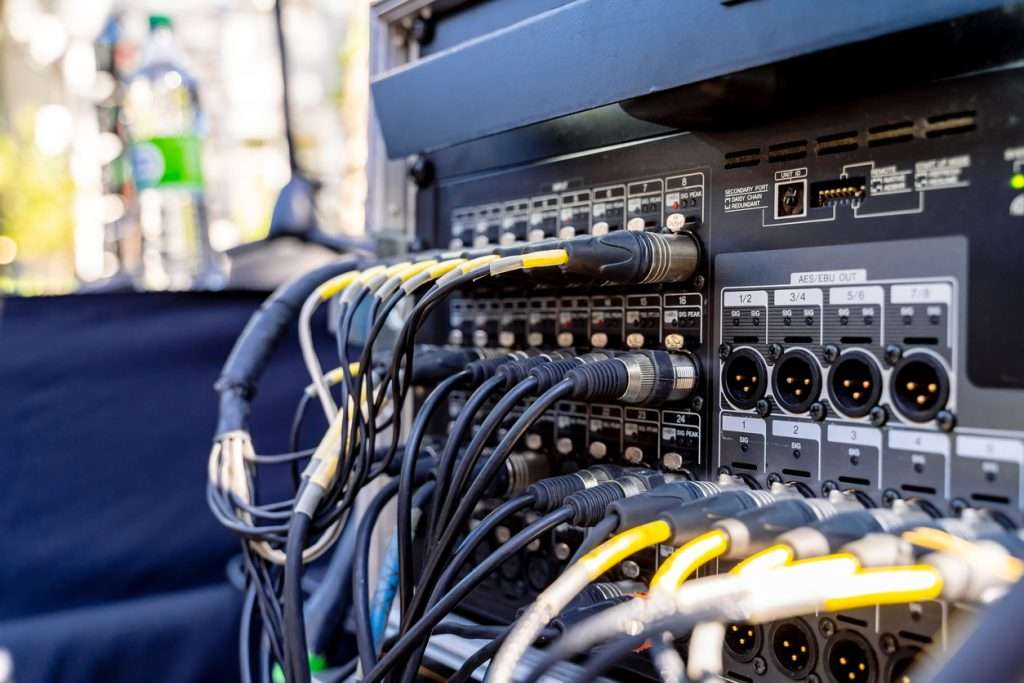
When selecting an amp compatible with your speakers, the two most important factors to bear in mind are impedance and power output efficiency. You can find the nominal impedance of your speakers, with 4, 8, or 16 ohms, on the speaker model number specifications or the manufacturer’s website.
Despite varying power specifications, the continuous power rating of your speakers should be your primary concern. To maximize signal levels and establish a gain setting, buy power amplifiers with built-in limiters that safeguard against distortion, signal chain overload, and clipping. If your goal is increasing the sound source volume through multiple speakers, a power amplifier device can help strengthen a line-level signal.
Get Started Finding the Perfect Amplifiers for Boosting Your Audio Signals
Amplifiers are pivotal in signal quality enhancement and interference reduction in all types of wireless communications, audio, and broadcasting equipment. Now that you understand the various types and amp categories, leverage the PartStack marketplace search engine to pick a suitable circuit. Discover high-quality amplifiers to improve your electronic circuits’ performance from top brands such as Texas Instruments, Analog Devices, Maxim Integrated, STMicroelectronics, NXP, and more on the PartStack marketplace.
References:
Intro to Amplifiers: https://www.explainthatstuff.com/amplifiers.html, https://www.electronics-tutorials.ws/amplifier/amp_1.html
Amplifier History: https://www.aes.org/events/133/historical/?ID=3200#:~:text=Abstract%3A,media%20of%20the%2020th%20century.
Types of Amplifiers: https://www.electronicshub.org/different-types-and-applications-of amplifiers/#:~:text=They%20are%201)%20Common%20Base,Source%20and%203)%20Common%20Drain.
Amplifier Classification: https://www.electronics-tutorials.ws/amplifier/amplifier-classes.html#:~:text=Class%20%E2%80%9CA%E2%80%9D%20amplifiers%20are%20considered,distortion%20levels%20when%20designed%20correctly.
Power Output: https://www.lifewire.com/amplifier-power-output-specifications-1845686
Amp Design Basics: https://www.engineersgarage.com/basics-of-audio-amplifier-1-9/#:~:text=An%20amplifier%20needs%20to%20be,constant%20over%20its%20operating%20range.
Amp Buying Guide: https://www.sweetwater.com/insync/power-amp-buying-guide/
Partstack’s editorial team is made up technical writers and engineering folks from around the world.





3 Responses
Hello I am so grateful I found your blog, I really found you
by error, while I was researching on Aol for something else, Regardless I am
here now and would just like to say thank you for a fantastic post and a all
round entertaining blog (I also love the theme/design), I don’t have time to
read through it all at the moment but I have book-marked it and
also included your RSS feeds, so when I have time
I will be back to read a great deal more, Please do keep up the
fantastic jo.
It is the best time to make some plans for the future and it’s time to be happy.
I have read this post and if I could I want to suggest you few interesting
things or suggestions. Maybe you could write next articles referring to this article.
I want to read even more things about it!
Thanks for your marvelous posting! I really enjoyed reading it, you happen to be a great author.I will always bookmark
your blog and will eventually come back sometime soon. I want to encourage you
to ultimately continue your great writing, have a nice morning!